Students
If you are interested in radio astronomy and galaxy evolution science and are looking for a Master’s or PhD project at UWA, please get in touch to discuss project opportunities. I can offer to supervise projects in the following areas:
- The HI mass function of galaxies
- Galaxy spin vector alignment
- Galactic high-velocity clouds
- “Dark” galaxies
- Other projects using WALLABY or DINGO data
Scholarship information
Note the following deadlines for the current round of 2027 UWA HDR scholarship applications:
Tue, 15 Sep 2026(international applicants; now closed)- Sat, 31 Oct 2026 (domestic applicants)
Project: The HI mass function of galaxies
One way to characterise the distribution of neutral hydrogen in the Universe is through the HI mass function (HIMF) which describes the space density of galaxies per HI mass interval. The HIMF follows a power-law at the low-mass end followed by a sharp exponential drop at the high-mass end (Fig. 1). Integrating over the HIMF provides us with the neutral gas density, ΩHI, of the Universe.
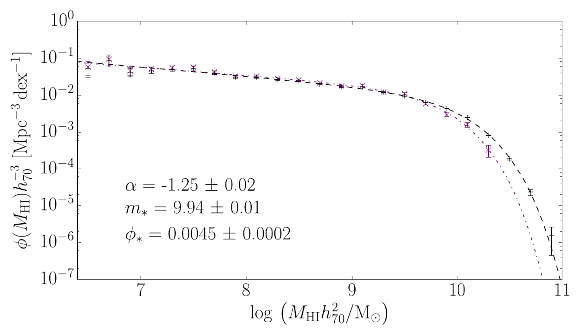
The WALLABY survey provides the opportunity to measure the HIMF in the local Universe with unprecedented precision. The aim of this project will be to extract all of the physical parameters (most notably fluxes and distances) needed to accurately measure the HI mass of the WALLABY galaxies and then construct the global WALLABY HIMF. This will provide a measurement of ΩHI at redshift 0 and can be compared to previous HIMF measurements from other surveys.
More interestingly, the large WALLABY sample can be split into subsamples of different environmental density (e.g. galaxies in dense clusters versus loose groups) to look for statistically significant variations. Such differences are expected to result from different mechanisms, such as ram pressure or gravitational interaction, removing gas from galaxies in denser environments. This should lead to measurable changes in the shape of the HIMF which WALLABY will be able to pick up thanks to its vast sky coverage.
Project: Galaxy spin vector alignment
One might naïvely expect that the discs of galaxies in the Universe are oriented randomly. However, numerical simulations of structure formation predict that the spin axes of galaxies should be preferentially aligned with the dark-matter filaments in which they reside. This effect is caused by the preferential direction from which galaxies are able to accrete mass and has recently been observationally confirmed with optical observations of small samples of galaxies.
Thanks to its large sky coverage and relatively high angular resolution of 30″, WALLABY will enable us to systematically measure the orientation of spin axes across large samples of tens of thousands of resolved galaxies for the first time. This will allow systematic measurements of the correlation of galaxy spin axis orientations across the local Universe to test the predictions from numerical simulations and theory.
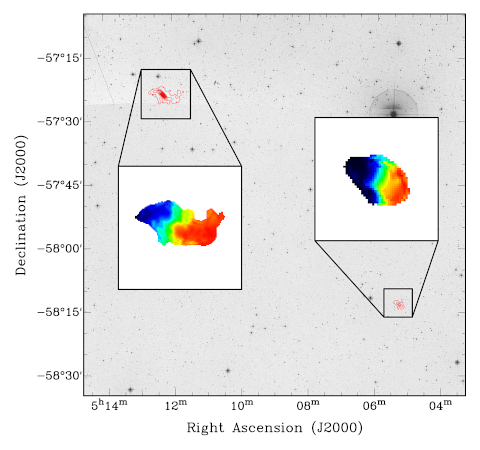
As an initial step, we can use the WALLABY data to check if the spin orientations of close galaxy pairs are preferentially aligned (Fig. 2), as would be expected for objects residing in the same filamentary structure. In a second step, a census of the filamentary structure in the local Universe can be obtained to check if the spin axes of galaxies residing in those filaments are aligned or misaligned with the filament geometry. The results can then be compared to the predictions from theory and numerical simulations to confirm or refute the current predictions.
Project: Galactic high-velocity clouds
Being the most abundant chemical element in the Universe, hydrogen plays a fundamental role in the evolution of galaxies as the fuel for star formation. Neutral hydrogen is most easily detectable in its atomic form through the 21-cm hyperfine structure line that can be observed with radio telescopes such as ASKAP in Western Australia.
Previous surveys of the sky in the 21-cm HI emission line have revealed a population of extraplanar gas clouds (Fig. 3) named “high-velocity clouds” (HVCs) due to their high radial velocities which are inconsistent with Galactic rotation, suggesting that HVCs represent gas that is located outside of the Milky Way disc, although their exact origin is still disputed.

Metallicity measurements indicate that HVCs have ≈ 10–50% solar metallicity which is higher than expected from primordial gas, but lower than Galactic gas, suggesting that HVCs may have been pre-processed outside of the Milky Way (e.g. in satellite galaxies) and are currently being accreted. However, other studies have suggested that HVCs could instead be due to outflows from a Galactic fountain process.
Using HI data from the HI4PI survey, we can systematically study the physical conditions within HVCs across the entire sky, including their density, temperature, pressure, gas phase and kinematics. We can then compare these parameters with the predictions from analytic and numerical models to estimate the stability, life time and future fate of the HVC gas. This will allow us to establish whether HVCs can reach the Galactic disc to become available as fuel for future star formation. If so, on what timescales does this happen and what is the corresponding accretion rate?
Project: “Dark” galaxies
One of the expectations from cosmological structure formation in the ΛCDM framework is the existence of dark-matter halos which have not turned into galaxies and hence do not contain stars. However, they might still contain detectable quantities of neutral atomic gas. Such halos are often referred to as “dark” galaxies.
Previous observations have so far failed to uncover any significant number of “dark” galaxies. Most of the candidates were later found to contain small numbers of stars in deep optical follow-up observations. In some cases the resulting HI-to-stellar mass ratios reach several hundred, and these extreme objects are commonly referred to as “almost dark” galaxies (Fig. 4).
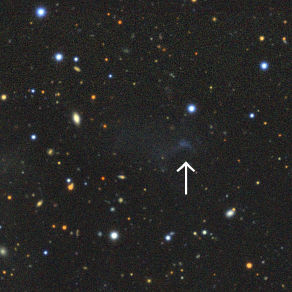
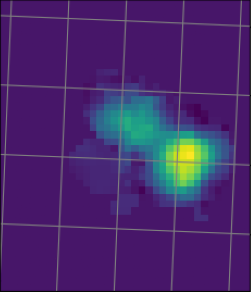
The WALLABY and DINGO surveys currently being conducted with the Australian SKA Pathfinder (ASKAP) are in an excellent position to systematically search for “dark” and “almost dark” galaxies across much of the sky. This will enable us to establish how common these extreme objects are, which physical parameter space they occupy and, most importantly, why they failed to form any significant amount of stars. Possibly reasons to explore include insufficient accretion of gas or large-scale gas loss due to either environmental processes or star-formation-driven gas outflows.